 Add to Chrome
 Add to Firefox
 Add to Edge
Con-DSO: Learning Short-Horizon Consistency Priors for RGB-D Direct Sparse Odometry
May 27, 2026
Visual odometry (VO) is a fundamental component in robotics and augmented reality. RGB-D direct VO benefits from metric depth measurements, but it can degrade in challenging environments, where dynamic objects, occlusions, illumination changes, and unreliable depth violate the short-horizon photometric and depth-geometric consistency assumptions used by direct alignment. Existing approaches mitigate these issues through semantic filtering, explicit occlusion reasoning, illumination adaptation, or hand-crafted geometric criteria, but often rely on external modules or fixed assumptions tailored to individual failure modes, limiting their flexibility and ability to handle diverse challenges in a unified manner. In this work, we propose Con-DSO, a consistency-aware RGB-D direct sparse odometry framework that predicts dense photometric and depth-geometric consistency uncertainty from temporally adjacent RGB-D frame pairs. The consistency network is trained using flow-guided photometric errors and projective depth-consistency errors, allowing consistency violations to be represented as pixel-level uncertainty. These pairwise uncertainty predictions are converted into a host-side quality prior for keyframe-based tracking. The prior is then applied to VO through quality-aware support-pixel selection and decoupled photometric-geometric weighting during pose estimation, enabling continuous attenuation of unreliable observations rather than hard rejection or threshold-based gating. Experiments on five public RGB-D benchmarks show substantial gains over direct RGB-D VO baselines, with over 20\% absolute trajectory error reduction on ICL-NUIM and 50\%--80\% reductions on RGB-D Scenes V2, TUM/Bonn Dynamic, and OpenLORIS sequences.

Experience Transfer for Multimodal LLM Agents in Minecraft Game
Apr 07, 2026Multimodal LLM agents operating in complex game environments must continually reuse past experience to solve new tasks efficiently. In this work, we propose Echo, a transfer-oriented memory framework that enables agents to derive actionable knowledge from prior interactions rather than treating memory as a passive repository of static records. To make transfer explicit, Echo decomposes reusable knowledge into five dimensions: structure, attribute, process, function, and interaction. This formulation allows the agent to identify recurring patterns shared across different tasks and infer what prior experience remains applicable in new situations. Building on this formulation, Echo leverages In-Context Analogy Learning (ICAL) to retrieve relevant experiences and adapt them to unseen tasks through contextual examples. Experiments in Minecraft show that, under a from-scratch learning setting, Echo achieves a 1.3x to 1.7x speed-up on object-unlocking tasks. Moreover, Echo exhibits a burst-like chain-unlocking phenomenon, rapidly unlocking multiple similar items within a short time interval after acquiring transferable experience. These results suggest that experience transfer is a promising direction for improving the efficiency and adaptability of multimodal LLM agents in complex interactive environments.
Efficient and Interpretable Multi-Agent LLM Routing via Ant Colony Optimization
Mar 13, 2026Large Language Model (LLM)-driven Multi-Agent Systems (MAS) have demonstrated strong capability in complex reasoning and tool use, and heterogeneous agent pools further broaden the quality--cost trade-off space. Despite these advances, real-world deployment is often constrained by high inference cost, latency, and limited transparency, which hinders scalable and efficient routing. Existing routing strategies typically rely on expensive LLM-based selectors or static policies, and offer limited controllability for semantic-aware routing under dynamic loads and mixed intents, often resulting in unstable performance and inefficient resource utilization. To address these limitations, we propose AMRO-S, an efficient and interpretable routing framework for Multi-Agent Systems (MAS). AMRO-S models MAS routing as a semantic-conditioned path selection problem, enhancing routing performance through three key mechanisms: First, it leverages a supervised fine-tuned (SFT) small language model for intent inference, providing a low-overhead semantic interface for each query; second, it decomposes routing memory into task-specific pheromone specialists, reducing cross-task interference and optimizing path selection under mixed workloads; finally, it employs a quality-gated asynchronous update mechanism to decouple inference from learning, optimizing routing without increasing latency. Extensive experiments on five public benchmarks and high-concurrency stress tests demonstrate that AMRO-S consistently improves the quality--cost trade-off over strong routing baselines, while providing traceable routing evidence through structured pheromone patterns.
Text summarization via global structure awareness
Feb 11, 2026Text summarization is a fundamental task in natural language processing (NLP), and the information explosion has made long-document processing increasingly demanding, making summarization essential. Existing research mainly focuses on model improvements and sentence-level pruning, but often overlooks global structure, leading to disrupted coherence and weakened downstream performance. Some studies employ large language models (LLMs), which achieve higher accuracy but incur substantial resource and time costs. To address these issues, we introduce GloSA-sum, the first summarization approach that achieves global structure awareness via topological data analysis (TDA). GloSA-sum summarizes text efficiently while preserving semantic cores and logical dependencies. Specifically, we construct a semantic-weighted graph from sentence embeddings, where persistent homology identifies core semantics and logical structures, preserved in a ``protection pool'' as the backbone for summarization. We design a topology-guided iterative strategy, where lightweight proxy metrics approximate sentence importance to avoid repeated high-cost computations, thus preserving structural integrity while improving efficiency. To further enhance long-text processing, we propose a hierarchical strategy that integrates segment-level and global summarization. Experiments on multiple datasets demonstrate that GloSA-sum reduces redundancy while preserving semantic and logical integrity, striking a balance between accuracy and efficiency, and further benefits LLM downstream tasks by shortening contexts while retaining essential reasoning chains.
Understanding Chain-of-Thought in Large Language Models via Topological Data Analysis
Dec 22, 2025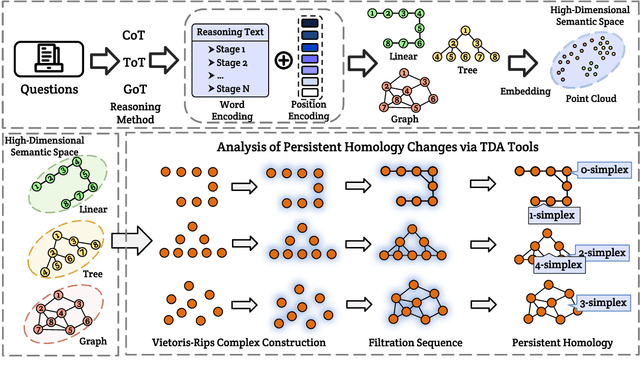
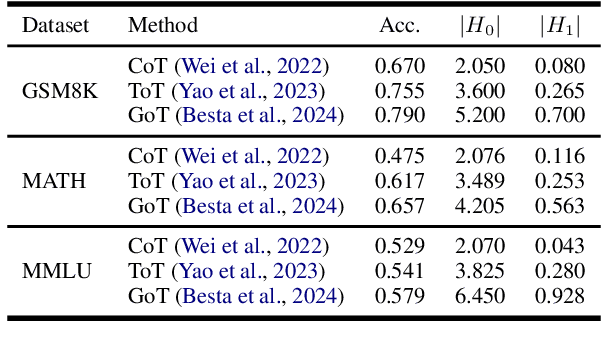
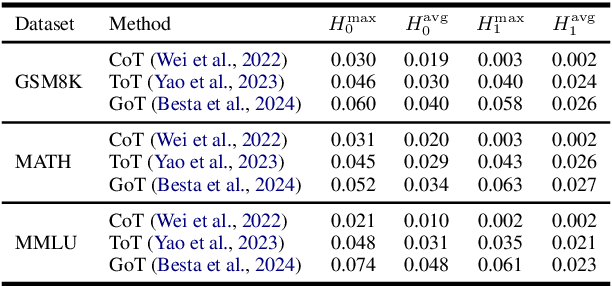
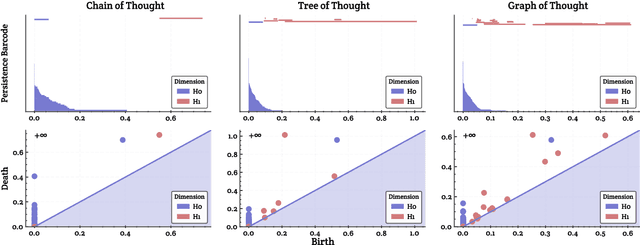
With the development of large language models (LLMs), particularly with the introduction of the long reasoning chain technique, the reasoning ability of LLMs in complex problem-solving has been significantly enhanced. While acknowledging the power of long reasoning chains, we cannot help but wonder: Why do different reasoning chains perform differently in reasoning? What components of the reasoning chains play a key role? Existing studies mainly focus on evaluating reasoning chains from a functional perspective, with little attention paid to their structural mechanisms. To address this gap, this work is the first to analyze and evaluate the quality of the reasoning chain from a structural perspective. We apply persistent homology from Topological Data Analysis (TDA) to map reasoning steps into semantic space, extract topological features, and analyze structural changes. These changes reveal semantic coherence, logical redundancy, and identify logical breaks and gaps. By calculating homology groups, we assess connectivity and redundancy at various scales, using barcode and persistence diagrams to quantify stability and consistency. Our results show that the topological structural complexity of reasoning chains correlates positively with accuracy. More complex chains identify correct answers sooner, while successful reasoning exhibits simpler topologies, reducing redundancy and cycles, enhancing efficiency and interpretability. This work provides a new perspective on reasoning chain quality assessment and offers guidance for future optimization.
RedVTP: Training-Free Acceleration of Diffusion Vision-Language Models Inference via Masked Token-Guided Visual Token Pruning
Nov 16, 2025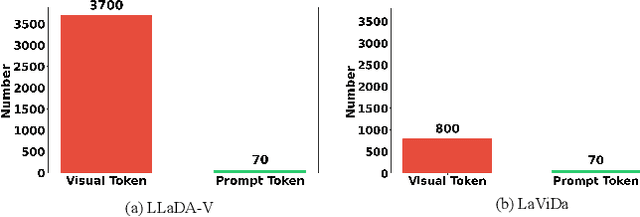
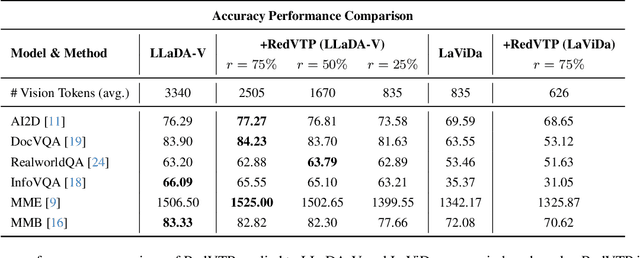
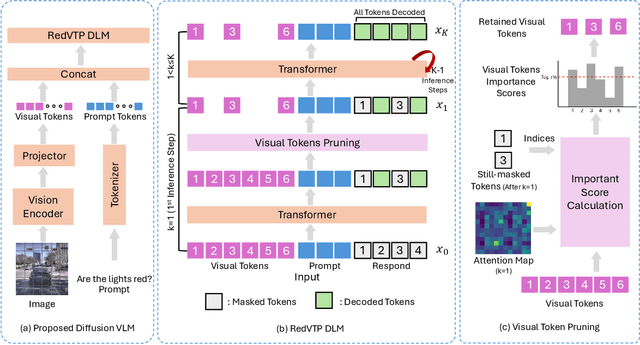
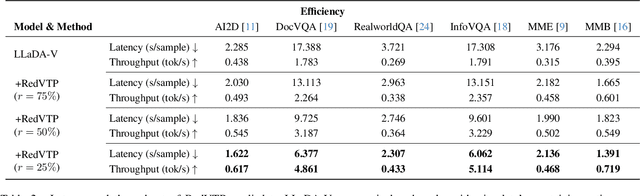
Vision-Language Models (VLMs) have achieved remarkable progress in multimodal reasoning and generation, yet their high computational demands remain a major challenge. Diffusion Vision-Language Models (DVLMs) are particularly attractive because they enable parallel token decoding, but the large number of visual tokens still significantly hinders their inference efficiency. While visual token pruning has been extensively studied for autoregressive VLMs (AVLMs), it remains largely unexplored for DVLMs. In this work, we propose RedVTP, a response-driven visual token pruning strategy that leverages the inference dynamics of DVLMs. Our method estimates visual token importance using attention from the masked response tokens. Based on the observation that these importance scores remain consistent across steps, RedVTP prunes the less important visual tokens from the masked tokens after the first inference step, thereby maximizing inference efficiency. Experiments show that RedVTP improves token generation throughput of LLaDA-V and LaViDa by up to 186% and 28.05%, respectively, and reduces inference latency by up to 64.97% and 21.87%, without compromising-and in some cases improving-accuracy.
Continual Knowledge Adaptation for Reinforcement Learning
Oct 22, 2025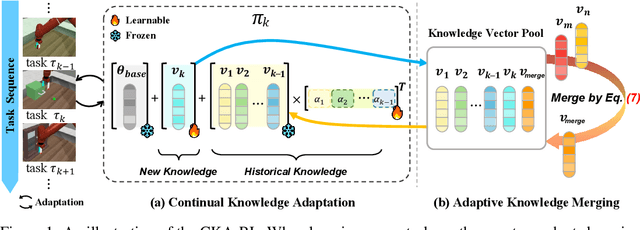
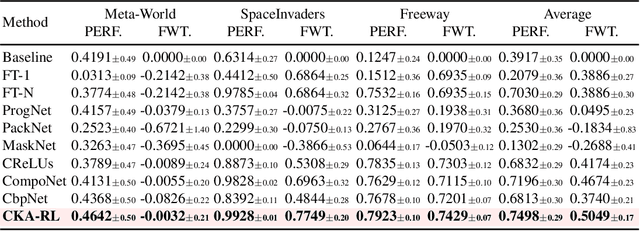
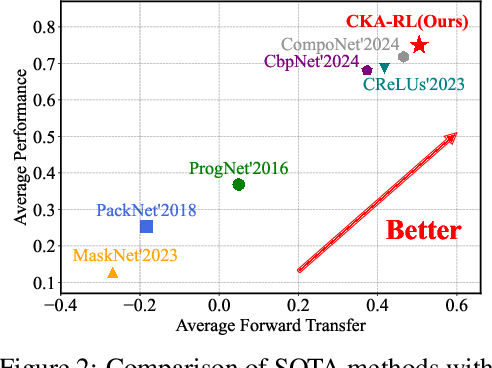
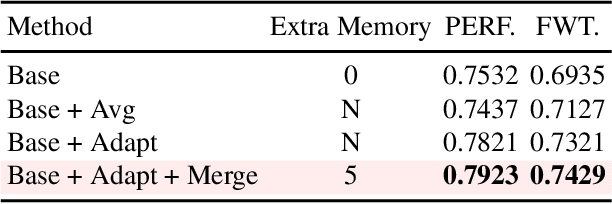
Reinforcement Learning enables agents to learn optimal behaviors through interactions with environments. However, real-world environments are typically non-stationary, requiring agents to continuously adapt to new tasks and changing conditions. Although Continual Reinforcement Learning facilitates learning across multiple tasks, existing methods often suffer from catastrophic forgetting and inefficient knowledge utilization. To address these challenges, we propose Continual Knowledge Adaptation for Reinforcement Learning (CKA-RL), which enables the accumulation and effective utilization of historical knowledge. Specifically, we introduce a Continual Knowledge Adaptation strategy, which involves maintaining a task-specific knowledge vector pool and dynamically using historical knowledge to adapt the agent to new tasks. This process mitigates catastrophic forgetting and enables efficient knowledge transfer across tasks by preserving and adapting critical model parameters. Additionally, we propose an Adaptive Knowledge Merging mechanism that combines similar knowledge vectors to address scalability challenges, reducing memory requirements while ensuring the retention of essential knowledge. Experiments on three benchmarks demonstrate that the proposed CKA-RL outperforms state-of-the-art methods, achieving an improvement of 4.20% in overall performance and 8.02% in forward transfer. The source code is available at https://github.com/Fhujinwu/CKA-RL.
GLIDE: A Coordinated Aerial-Ground Framework for Search and Rescue in Unknown Environments
Sep 17, 2025We present a cooperative aerial-ground search-and-rescue (SAR) framework that pairs two unmanned aerial vehicles (UAVs) with an unmanned ground vehicle (UGV) to achieve rapid victim localization and obstacle-aware navigation in unknown environments. We dub this framework Guided Long-horizon Integrated Drone Escort (GLIDE), highlighting the UGV's reliance on UAV guidance for long-horizon planning. In our framework, a goal-searching UAV executes real-time onboard victim detection and georeferencing to nominate goals for the ground platform, while a terrain-scouting UAV flies ahead of the UGV's planned route to provide mid-level traversability updates. The UGV fuses aerial cues with local sensing to perform time-efficient A* planning and continuous replanning as information arrives. Additionally, we present a hardware demonstration (using a GEM e6 golf cart as the UGV and two X500 UAVs) to evaluate end-to-end SAR mission performance and include simulation ablations to assess the planning stack in isolation from detection. Empirical results demonstrate that explicit role separation across UAVs, coupled with terrain scouting and guided planning, improves reach time and navigation safety in time-critical SAR missions.
Re-Initialization Token Learning for Tool-Augmented Large Language Models
Jun 17, 2025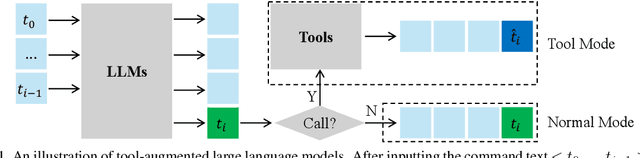
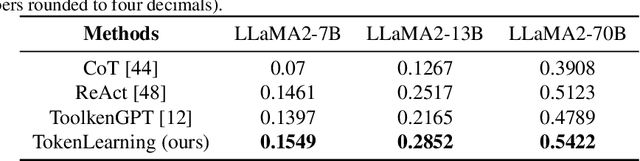
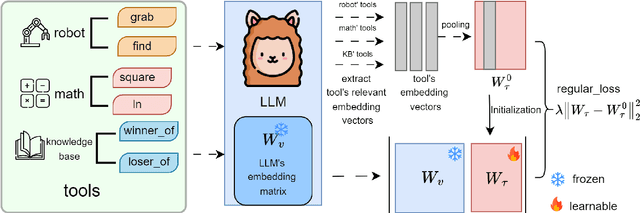
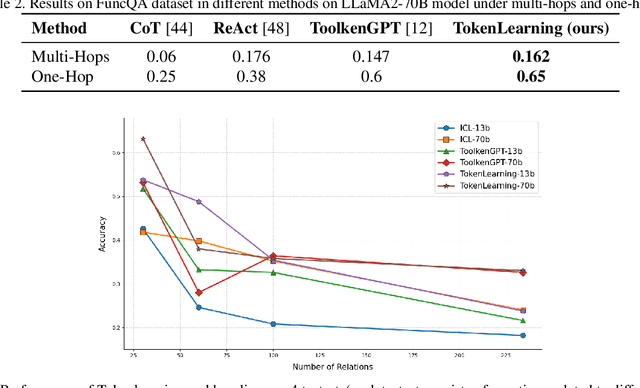
Large language models have demonstrated exceptional performance, yet struggle with complex tasks such as numerical reasoning, plan generation. Integrating external tools, such as calculators and databases, into large language models (LLMs) is crucial for enhancing problem-solving capabilities. Current methods assign a unique token to each tool, enabling LLMs to call tools through token prediction-similar to word generation. However, this approach fails to account for the relationship between tool and word tokens, limiting adaptability within pre-trained LLMs. To address this issue, we propose a novel token learning method that aligns tool tokens with the existing word embedding space from the perspective of initialization, thereby enhancing model performance. We begin by constructing prior token embeddings for each tool based on the tool's name or description, which are used to initialize and regularize the learnable tool token embeddings. This ensures the learned embeddings are well-aligned with the word token space, improving tool call accuracy. We evaluate the method on tasks such as numerical reasoning, knowledge-based question answering, and embodied plan generation using GSM8K-XL, FuncQA, KAMEL, and VirtualHome datasets. The results demonstrate clear improvements over recent baselines, including CoT, REACT, ICL, and ToolkenGPT, indicating that our approach effectively augments LLMs with tools through relevant tokens across diverse domains.
FPAN: Mitigating Replication in Diffusion Models through the Fine-Grained Probabilistic Addition of Noise to Token Embeddings
May 28, 2025Diffusion models have demonstrated remarkable potential in generating high-quality images. However, their tendency to replicate training data raises serious privacy concerns, particularly when the training datasets contain sensitive or private information. Existing mitigation strategies primarily focus on reducing image duplication, modifying the cross-attention mechanism, and altering the denoising backbone architecture of diffusion models. Moreover, recent work has shown that adding a consistent small amount of noise to text embeddings can reduce replication to some degree. In this work, we begin by analyzing the impact of adding varying amounts of noise. Based on our analysis, we propose a fine-grained noise injection technique that probabilistically adds a larger amount of noise to token embeddings. We refer to our method as Fine-grained Probabilistic Addition of Noise (FPAN). Through our extensive experiments, we show that our proposed FPAN can reduce replication by an average of 28.78% compared to the baseline diffusion model without significantly impacting image quality, and outperforms the prior consistent-magnitude-noise-addition approach by 26.51%. Moreover, when combined with other existing mitigation methods, our FPAN approach can further reduce replication by up to 16.82% with similar, if not improved, image quality.